Sundas Journal
When is Hajj 2026? Arafah Day, Eid al-Adha 2026 Dates
- Author
- Sundas Foundation
- Published
- 16 April 2026
- Read time
- 7 min read
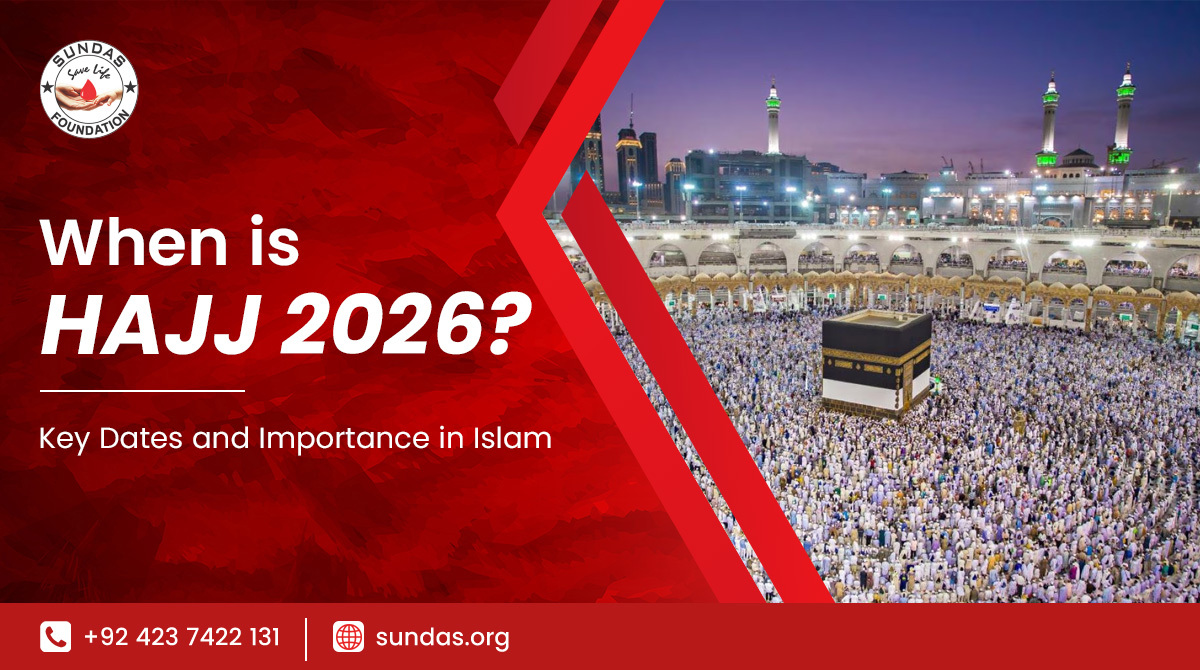
Hajj is one of the five pillars of Islam. Performing Hajj is compulsory for every eligible Muslim at least once in their lifetime. Every year, Hajj takes place during the same period, in the month of Dhul Hijjah. Hajj starts from the 8th of Dhul Hijjah and lasts until the 12th of Dhul Hijjah.
This article is a detailed account of Hajj in 2026. Let’s explore when the Hajj is in 2026 and how to perform the Hajj with complete rituals. As well as this, we will also discuss the mistakes every pilgrim must avoid during Hajj to have a safe and memorable Hajj experience. So, let’s begin understanding Hajj here:
What is Hajj?
Among the five pillars of Islam, Hajj is marked as the fifth one. It is a sacred activity in Islam that Muslims perform every year at the Holy Masjid of Al-Haram in Makkah, Saudi Arabia. A financially stable Muslim must perform Hajj at least once in his lifetime. If someone is wealthy enough that he can perform Hajj more than once, he is permitted to do so. However, their intention to perform Hajj must be purely for the cause of Allah or to seek Allah’s forgiveness and pleasure. There are three different types of Hajj in Islam, including;
1- Hajj Al-Ifrad (Solo Hajj): It is the phenomenon in which Muslims perform only Hajj without Umrah.
2- Hajj Al-Qiran (Combined Hajj and Umrah): In this type of Hajj, Muslims perform Hajj and Umrah together without a break in Ihram.
3- Hajj Al-Tamattu (Relaxed Hajj): It is a type in which Muslims first perform Umrah, then take a break, and then perform Hajj.
When is Hajj 2026?
In 2026, it is expected that Hajj will be performed on 25th May, 2026. However, the exact Hajj schedule depends on the moon sighting in Saudi Arabia. Remember that the Hajj event will start on the 8th of Dhul Hijjah according to the Saudi calendar. Usually, the Hajj is completed in 5 or 6 days and comprises a series of rites and rituals.
Hajj Applications in Pakistan 2026?
Every year, candidates from Pakistan who wish to perform Hajj apply for the Hajj through a government Hajj scheme. You can find a complete Hajj Details 2026 for Pakistanis proposed by the government of Pakistan or the Ministry of Religious Affairs and Interfaith Harmony. Through this government portal, Hajj Zaireen can get important updates regarding Hajj registration, Hajj application status, Hajj flight schedule 2026, and Hajj Policy 2026.
Who is Eligible for Hajj?
To perform Hajj, the candidates or Zaireen must fulfill the following conditions:
1- Be an Adult Muslim: The first and foremost condition to perform Hajj is that the candidate must be an adult Muslim. Hajj is not obligatory for kids or the underage.
1- Must be a Sane Person: To perform Hajj, the candidates or Zaireen must be sane or mentally well.
2- Must be a Free Person: To perform Hajj, the person must be free, as slaves are not liable for Hajj.
3- A Financially Stable Person: To perform Hajj, one must be financially strong to bear the expenses of Hajj without any problem.
4- Hajj for Women: For women, it is advised to perform Hajj with their Mahram, such as husband, father, son, brother, nephew, uncle, etc.
How to Perform Hajj?
The duration of Hajj is five or six days, comprising several activities to perform to complete it. Below are the must-do activities during Hajj to complete this obligation. However, one must perform each activity carefully to avoid mistakes:
1- Prepare for Hajj: Ensure you have a valid visa, financial readiness, and good physical and mental health.
2- Enter Ihram: Wear simple, modest clothing and make the intention to perform Hajj. Men wear two white cloths, while women wear modest clothing.
3- Arriving in Makkah (Tawaf al-Qudum): Perform Tawaf (seven circles around the Kaaba) upon arrival and pray two rak’ahs near Maqam Ibrahim.
3- Sa’i (Walking between Safa and Marwah): Walk seven times between the hills of Safa and Marwah as part of the pilgrimage.
4- Travel to Mina: On the 8th day of Dhul-Hijjah, travel to Mina, where you will stay overnight and pray.
5- Arafat (The Day of Arafah): Spend the day at Arafat praying and supplicating, asking Allah for forgiveness.
6- Muzdalifah (Night under the Stars): Spend the night in Muzdalifah, pray Maghrib and Isha together, and collect pebbles for the next ritual.
7- Jamarat (Stoning the Devil): Throw seven pebbles at the largest pillar in Mina to reject Satan’s temptations.
8- Sacrifice and Tahallul (Shaving/Cutting Hair): After stoning, perform a sacrifice (usually a sheep or goat) and either shave your head (for men) or trim your hair (for women).
9- Tawaf al-Ifadah: Perform Tawaf around the Kaaba again, then offer two rak’ahs at Maqam Ibrahim.
10- Stoning the Jamarat Again: On the 11th and 12th day, throw seven pebbles at each of the three pillars.
11- Tawaf al-Wada (Farewell Tawaf): Before leaving Makkah, make a final Tawaf around the Kaaba.
Mistakes to Avoid While Performing Hajj?
Hajj is the most sacred and biggest event in Islam, requiring full attention and Niyyah. Muslims sometimes make mistakes during Hajj, which can lose the real charm and joy of Hajj. Here are the common mistakes discussed. Read them carefully and try to avoid them during Hajj:
1- Not Learning the Hajj Rituals: Muslims do not learn the rituals and get disturbed during Hajj. Learn everything before performing Hajj.
2- Wearing Ihram Incorrectly: Safety pins and stitched clothes are not allowed for Ihram. You must also learn everything else before wearing Ihram.
3- Control Your Anger or Emotions: You may face a long walk, heat, and a crowd, causing frustration. But you must control your anger and emotions.
4- Getting Lost from Your Group: Commonly, people get lost from the group. Keep your ID badge with your name, hotel name, and group name with you.
5- Missing Important Acts or Days: Do not ignore any activity and learn properly about the importance of every act and day during Hajj.
6- Carrying Too Much Luggage: Do not carry too much luggage with you, as it can disturb you while walking.
7- Too Much Photography: Do not get involved in photography too much, but keep focusing on making Duas and Dhikr.
8- Health Conditions: Many people do not take care of their health and get sick. Take care of your health and stay fit to perform Hajj properly.
Give Your Donations to Sundas Foundation This Dhul Hijjah
Those who are going to perform Hajj this year, may Allah accept their Hajj. However, those who are not going are advised to do good deeds on this day. Muslims can donate on this day to seek Allah’s forgiveness and pleasure. Give your donations to Sundas Foundation on Hajj day and help us treat the poor patients suffering from Thalassemia, Hemophilia, and other blood disorders.
Frequently Asked Questions
When is Hajj in 2026?
It is estimated that the Hajj 2026 will be performed on May 25th, 2026. However, the final date will be decided based on the moon sighting in Saudi Arabia.
Who can perform Hajj?
Every adult Muslim who is sane and financially stable must perform Hajj once in a lifetime.
What is the Hajj application 2026 Pakistan last date?
To determine the Hajj application 2026 last date in Pakistan, keep exploring the official website of the Ministry of Religious Affairs and Interfaith Harmony.
What is the Dua that Hajj pilgrims offer?
Below is the Hajj Dua pilgrims offer during Hajj:
"Labbaik, Allahumma Labbaik, Labbaik La Sharika laka Labbaik. Inn-al-Hamda Wan-Ni'mata Laka wal-Mulk, La Sharika Lak.”
“At Your service, Allah, at Your service. At Your service, You have no partner, at Your service. Truly, all praise, favour, and sovereignty is Yours. You have no partner.”
When is Eid ul-Adha in Pakistan in 2026?
In Pakistan, it is estimated that Eid ul Adha will be celebrated on the 26th or 27th of May, 2026. However, the final Eid schedule will be announced once the Dhul Hijjah moon is sighted in Pakistan.

Written by Sundas Foundation
A non-profit established in 1998 and registered with the Punjab Charity Commission, dedicated to free, round-the-clock care for patients with Thalassemia, Hemophilia and other blood disorders at 12 centers across Pakistan.